
Generated, Not Designed: The Receipt Is Not the Meal
The most dangerous thing AI does to our craft isn't replacement. It's the quiet conviction that the artifact on the screen is the same as the work behind it.

There’s a sentence I keep writing in margins when I review work, and I’ve started writing it so often I want to put it down properly here, where it can do some good.
The form is there. The fit is not.
I’m writing it on Figma comments. I’m writing it in the margin of strategy decks that arrive in my inbox at 11pm. I’m writing it on PRDs that read like they were assembled rather than thought. I’m saying it, increasingly, out loud in studio reviews. At first carefully, the way you’d flag a small problem. Now bluntly, because the problem isn’t small.
The moment we’re in is late 2026. Every studio in Milan is running three, ten…twenty agents in parallel. Every junior is shipping more screens in a week than I shipped in my first year. This argument needs to be repeated until it becomes uncomfortable. So I’m going to say it uncomfortably.
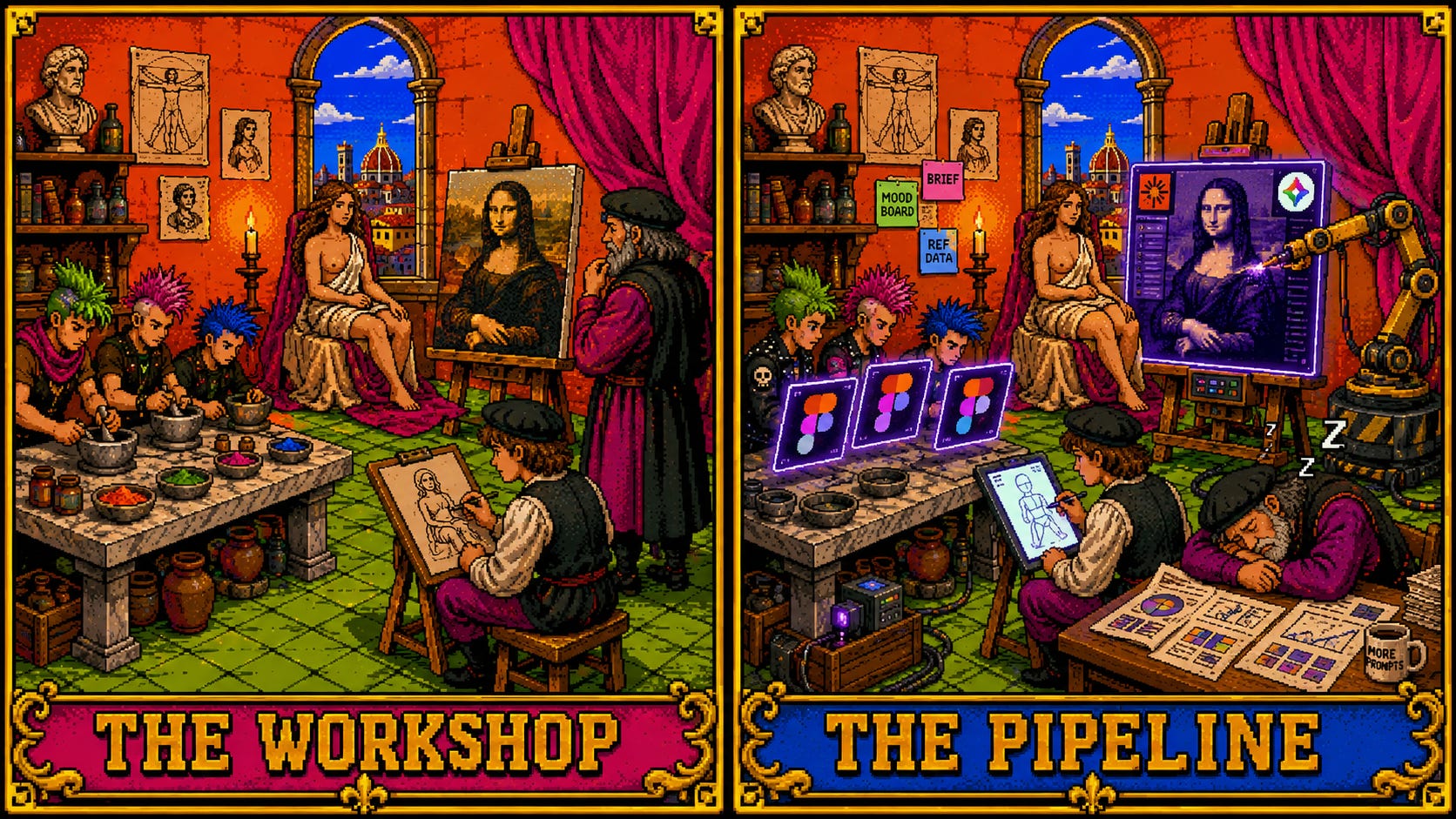
Here’s the wager up front:
Every industry is about to spend the next eighteen months confusing form generation with thinking, and the work that results is going to be the most polished, most ambitious, most fundamentally broken work we’ve ever shipped.
I’m writing from design because that’s the floor I stand on.
But this is happening to strategists, engineers, marketers, lawyers, analysts, executives. Everyone whose job used to be the work of producing a coherent artifact. Some of the broken work will be ours.
Let that land.
The Misunderstanding
Let me name what’s actually being misunderstood. Tools keep promising to generate interfaces faster, move words to product instantly, collapse design into code. The assumption underneath all of them is that design is the act of producing.
It isn’t. It never was.
The hard part of design is not what AI can speed up. It’s the part that takes time, that resists automation, that you cannot delegate to a swarm. Understanding the problem well enough to know what should exist at all. Not how it should look. Not how it should flow. Whether. And what shape. Those two questions are the entire job.
Christopher Alexander, in Notes on the Synthesis of Form, called this the search for a good fit between a form and its context. The book came out in 1964. It’s older than most of the people now reinventing design with agents. Context, in Alexander’s sense, isn’t the background. It’s the full set of forces that make a problem what it is: human needs, technical constraints, conflicting requirements, habits, edge cases, the relationships you don’t notice until you’ve sat with them for three weeks. Bad design appears where those forces stay unresolved. Good design appears where the misfits have been worked through, painfully, slowly, and almost always in conversation with someone who disagrees with you.
You cannot generate that. You can only do the work.
What AI Actually Encourages
This is where I diverge from the techno-optimist line currently dominating LinkedIn.
AI doesn’t help you understand the problem. In practice, it does the opposite. It generates plausible outputs at speed, and plausibility is the most seductive substitute for understanding humans have ever invented.
Watch yourself the next time you prompt. The arc is almost always the same. You give the model a thin brief. It returns four polished screens. You pick the one that looks closest to right. You iterate on its surface. Three rounds in, the form has stabilised. But the problem has never been examined. The model didn’t ask you what the user actually does at 7 a.m. when the notification fires. The model didn’t ask whether the feature should exist at all. The model gave you a form that fits the prompt, not the context.
And because the form looks resolved, you stop looking for the misfits.
This is what I meant in the keynote a few weeks ago when I said ease is the greatest threat to progress. I wasn’t being grand. I was describing exactly this loop. The faster the rendering, the smaller the window in which a designer can actually disagree with themselves. And design, the real kind, the kind that produces products people return to, is almost entirely the act of disagreeing with yourself in public until something true survives.
The Tell
You can already see the result. Products that look polished, ambitious, and impressive at first glance. Beautiful empty states. Confident type. Animations that justify themselves. Then you actually use them and they begin to come apart in the hand.
Decisions that were never fully made. Edge cases nobody sat with. Two features fighting each other because nobody noticed. A flow that works the first time and breaks the second. Copy that sounds correct but reveals, on second read, that the writer had no model of who they were writing to.
The form is there. The fit is not.
I’ve reviewed twelve products in the last six months that fit this description exactly. Three of them are from teams I respect enormously. All twelve were shipped in record time. All twelve are quietly being walked back, feature by feature, as the misfits surface in production.
This is the predictable outcome of a workflow that mistakes generated form for solved problems.
The Experience of Competence
Now I have to widen the lens, because the broken-product version of this story is only half of it. The other half is about people. And it’s the half I’ve been most reluctant to write down, because writing it down means saying something that is socially expensive to say in 2026.
So I’ll just say it.
The worst thing AI is doing to our industry right now is giving the experience of competence to people who are not competent. People who, before these tools existed, could not produce. They could not write a coherent two-page brief. They could not organise a thought into a structure that survived a second read. They could not hold a problem in their head long enough to know whether the answer they were about to ship made any sense. And because they could not produce, they didn’t produce. The system worked. Their incompetence was visible. They were either coached, reassigned, or routed around.
That circuit is now broken.
The same people are now generating thirty-page strategy documents in an afternoon. They’re shipping forty-screen Figma files by Wednesday. They’re running multi-agent pipelines that produce decks, PRDs, design rationales, research synthesis, executive summaries. All of it formatted, all of it confident, all of it in a register that reads like someone who knows what they’re doing. They forward these artifacts to you. They ask you to review them. They follow up if you haven’t read them by end of day. They are, for the first time in their professional lives, having the experience of being competent.
They are not competent. The artifact is competent. The model is competent. The pipeline is competent. They are the conduit, and the conduit has confused itself for the source.
This is making the rest of us miserable.
I want to be careful here, because the cheap version of this argument is just gatekeeping. The senior designer’s lament that the kids today have it too easy. That’s not what I’m describing. I have no problem with juniors using these tools. I run those pipelines myself. I’ve spent eighteen months arguing on this Substack that the trajectory from interfaces to experiences to agent design is the most important shift in our craft since the smartphone, and that designers who refuse to engage with it are choosing to be left behind.
That’s not the argument.
The argument is about what the tool reveals about the user. If you were a careful thinker before AI, AI makes you faster. The thirty-page document you generate is denser, sharper, more thoroughly cross-referenced than the one you’d have written by hand, because you’re the editor of the model and your editorial judgment is what makes the artifact worth reading. The model amplifies you because you have something to amplify.
If you were not a careful thinker before AI, AI makes you visible in a way you weren’t before. And the visibility is hollow. The thirty-page document you generate is long, formatted, citation-laden, and incoherent. It looks like work. It is not. And the people on the receiving end of it, the colleagues, the clients, the reviewers, are now spending their afternoons doing the work the author should have done, which is figuring out whether any of this makes sense. The cognitive load got displaced, not eliminated. It moved from the producer to the reader. The producer experiences competence. The reader experiences exhaustion.
This is the part of the AI transition nobody is honest about. We talk about productivity gains. We don’t talk about whose productivity, at whose expense.
The tell, in design specifically, is when you ask the producer a follow-up question. Why did you make this choice? What did you consider and reject? What’s the strongest argument against this concept? The competent practitioner, AI-assisted or not, has answers. They’ve already had the conversation with themselves. They argued the concept down and watched it survive. The merely-AI-amplified practitioner does not have answers, because the conversation never happened. The model returned the artifact. The artifact looked good. They forwarded it. That was the entire process.
You can spot it in three minutes if you know to ask.
The reason this matters, and the reason I’m willing to say it on a Substack with my actual name on it, is that this dynamic is corroding the studio from inside. Senior designers are quietly burning out reviewing slop. Mid-level practitioners are watching colleagues who can’t think get promoted on the basis of artifact volume. Juniors who are actually trying to learn the craft are being mentored alongside peers who are skipping the learning entirely, and the peers are shipping faster, and the lesson the juniors are taking from this is exactly the wrong lesson.
I have watched this happen. I have, in moments I’m not proud of, contributed to it. I’ve accepted an artifact at face value because the deadline was Friday and the formatting was fine. The pressure to do this is enormous. The whole organisational machine is now optimised to reward output volume, and AI has just made output free. So we accept it. We forward it. We promote on it.
And the products we ship reflect it. Polished. Ambitious. Empty.
The receipts pile up. Nobody asks about the meal.
Why I Still Design Visually
Here’s a confession I’ve been thinking and not saying loudly enough.
I still prefer doing concept design visually over prompting.
Not because I distrust the models. I run more agentic pipelines in a week than most teams run in a quarter. I prefer it because working visually keeps me close to the problem, and is slow enough that I can think while I work.
Moving things around. Testing relationships. Shifting a component three pixels and noticing that the entire hierarchy collapsed. That isn’t separate from thinking. It is the thinking. Clarity arrives through the doing.
There’s something cathartic about it, in the same way writing is cathartic. Writing forces you to organise thought because the act of getting it on the page is itself a structural exercise. Asking AI to write for you produces text. It rarely rearranges your thinking. Design works the same way. The value isn’t only in the output. It’s in the gradual understanding that emerges through the work, and that understanding is the actual product of the design process.
What AI Is Actually Good For
I don’t want this to read as a refusal. I’m on record, repeatedly, as someone who believes the trajectory from interfaces to experiences to agent design is the most important shift in our craft since the smartphone. That trajectory only works because of these models.
But the place AI sits in a serious design process is specific. It can prototype. It can explore. It can surprise you. It can run forty variants of a flow in the time it used to take to wireframe one. It can simulate users you’d never get into a research room. It can pressure-test a concept by adversarially attacking it before you ever ship.
That is real, and I use it daily.
What it cannot do, what it should not do, is replace the work of understanding the problem. Judgment, conversation, tension, time. Those four words are not workflow inefficiencies waiting to be optimised. They are the design process. Strip them out and you don’t get faster design. You get faster decoration.
Orchestration, not decoration. I keep saying it. The reason I keep saying it is that the industry keeps confusing the two.
The Risk, Stated Plainly
The risk is mistaking generated form for solved problems.
That’s the most precise sentence I can write about our moment, and I want to extend it:
The risk is building an industry-wide reflex where the existence of a polished artifact is treated as evidence the problem is understood.
That reflex is already forming. You can see it in pitch decks where the design phase is six days. You can see it in roles being rewritten to demote research and inflate execution. You can see it in studios, including, I’ll confess, my own at moments, where the round time has compressed so aggressively that there is genuinely no space left for someone to say I don’t think this is the right problem.
When that voice disappears, design disappears with it. What’s left is production.
What This Means If You Run a Team
A few things I’m protecting in my own studio, in case any of this is useful:
Slow rounds, on purpose. Not for every project. But for the load-bearing decisions, the ones the rest of the system rests on, I am deliberately not letting the agents run. The team works visually, by hand, for one full day, before any model is invited in. That day is non-negotiable.
Disagreement as a deliverable. Every concept review now requires a written counter-argument. Not from me. From someone on the team. If nobody can articulate why the concept might be wrong, we haven’t understood it well enough to ship it.
The agent budget. We track it. Not for cost. For thinking time displaced. If a project’s agent runs are growing faster than its decisions are, that’s a signal to stop and ask what we’re actually doing.
Misfit logs. Every product we ship now has a misfit log. An explicit list of the contextual forces we know we haven’t fully resolved. It goes in the handover. It survives the launch. It is the most useful artifact we produce.
None of these are revolutionary. They’re the practices a serious studio has always had. AI didn’t make them obsolete. It made them load-bearing.
Design never left. That’s worth saying clearly. It didn’t go away. It didn’t get replaced. It got buried under the volume of artifacts that look like design and aren’t. The work is still here. The practitioners are still here. The discipline is still here. What’s new is the noise on top of it, and our willingness to mistake the noise for the signal.
So when I say design, I mean what it has always meant: the ability to make the right call at speed and then craft every detail until the product feels inevitable.
I’d add one line to that now, after a few months of watching the studio floor:
The right call is not the one the model returned first. The right call is the one you arrived at after the model, the team, the constraint sheet, the user, and your own discomfort all had a turn. That arrival is the work. The screen is the artifact of the work, not the work itself.
A receipt tells you a meal happened. It doesn’t tell you whether the meal was any good, who it was for, whether the kitchen meant it, or whether anyone at the table left full. You cannot eat a receipt.
Generated, not designed. That’s the line I want us to be honest about. Every industry is producing more receipts than it has ever produced in its history, and confusing the volume with abundance.
The meal is still made by hand. It always was.
That is a striking article. I let myself disagree with you, partially. The confuse of form and fit was always there, it is proved by the tons of beautiful designs on Dribbble, it is proved by my own experience - every time I join the project, first I get - the folder with polished designs made by design agency, which will never be applied to the product because they won’t work. The AI makes this production process faster - yes. And that is actually good, because the beautiful but not functional picture now worth less. And good designs anyway need the final artefacts :)
The understanding that proper thinking and testing of wireframes makes not only good design, it makes the design that will work - that understanding was often a rear thing, and always a thing came via suffering from beautiful non-functional designs.
I believe there should be a rise of need in UX specialists sooner or later - to fix all the plausible interfaces :)